

Single Mode vs. Multimode Fiber Optic Cable
Although single-mode fiber and multi-mode fiber are widely used in various applications, the difference between them is still confusing. When installing fiber optic cabling, one of the most important questions is whether to install single mode fiber or multi-mode fiber. This article will compare single-mode and multi-mode fibers around basic structure, bandwidth, fiber distance, fiber color, and cost.
What’s the Difference Between Single Mode and Multimode Fiber Optic Cable?
Single mode fiber is a common fiber used for long distance transmission. Single mode fiber is a single glass fiber bundle used to transmit single mode or light. Single mode fiber has only one transmission mode. Single mode fiber is also called single mode fiber, single mode fiber, single mode fiber and single mode optical waveguide.
Multi-mode fiber is a kind of fiber designed to transmit multiple rays or modes at the same time, and the reflection angle of each ray or mode in the fiber core is slightly different.
Construction
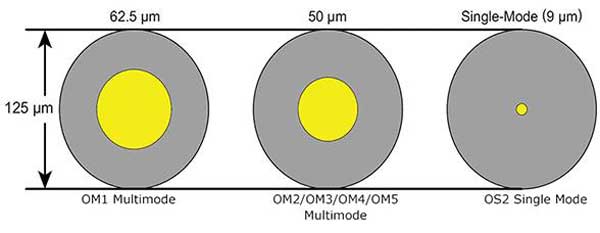
The core diameter of single-mode fiber is much smaller than that of multi-mode fiber Single mode fiber is designed to propagate a single optical mode, while multi-mode supports multiple simultaneous optical modes. Single mode and multi-mode cables are constructed differently. The fiber core of a single mode fiber optic cable is 9 μm, and the fiber core of modern multi-mode fiber optic cables is 50 μm, but the fiber core of older fiber optic cables (especially OM1 optical cables) is 62.5 μm.
Bandwidth
The bandwidth of single-mode fiber is significantly higher than that of multi-mode fiber Single mode cables support light sources with higher brightness, higher power, and lower attenuation. And multi-mode relies on the transmission of multiple light modes with lower brightness and higher attenuation.
Distance
single-mode fiber supports short distance transmission and long distance transmission, regardless of signal bandwidth and/or resolution. The transmission distance of single mode fiber can reach 40 kilometers or more without damaging the signal, so it is very suitable for long distance applications. The maximum transmission distance of multi-mode affected by the cable grade is much shorter, making it an ideal choice for indoor applications.
Color
single-mode fibers are covered with yellow outer sheaths, and multi-mode fibers are covered with orange or light green sheaths.

